There is something incredibly hypnotic about the perfect soft-boiled egg. But when you take that perfectly cooked, tender egg and drape it in a vibrant, glossy red chili sauce, you elevate it to an entirely new culinary level.
These Spicy Gochujang Eggs are the ultimate combination of rich, creamy textures and bold, fiery flavors. If you are looking for a show-stopping breakfast, a protein-packed snack, or an unforgettable addition to your favorite rice or noodle dish, you have found it.
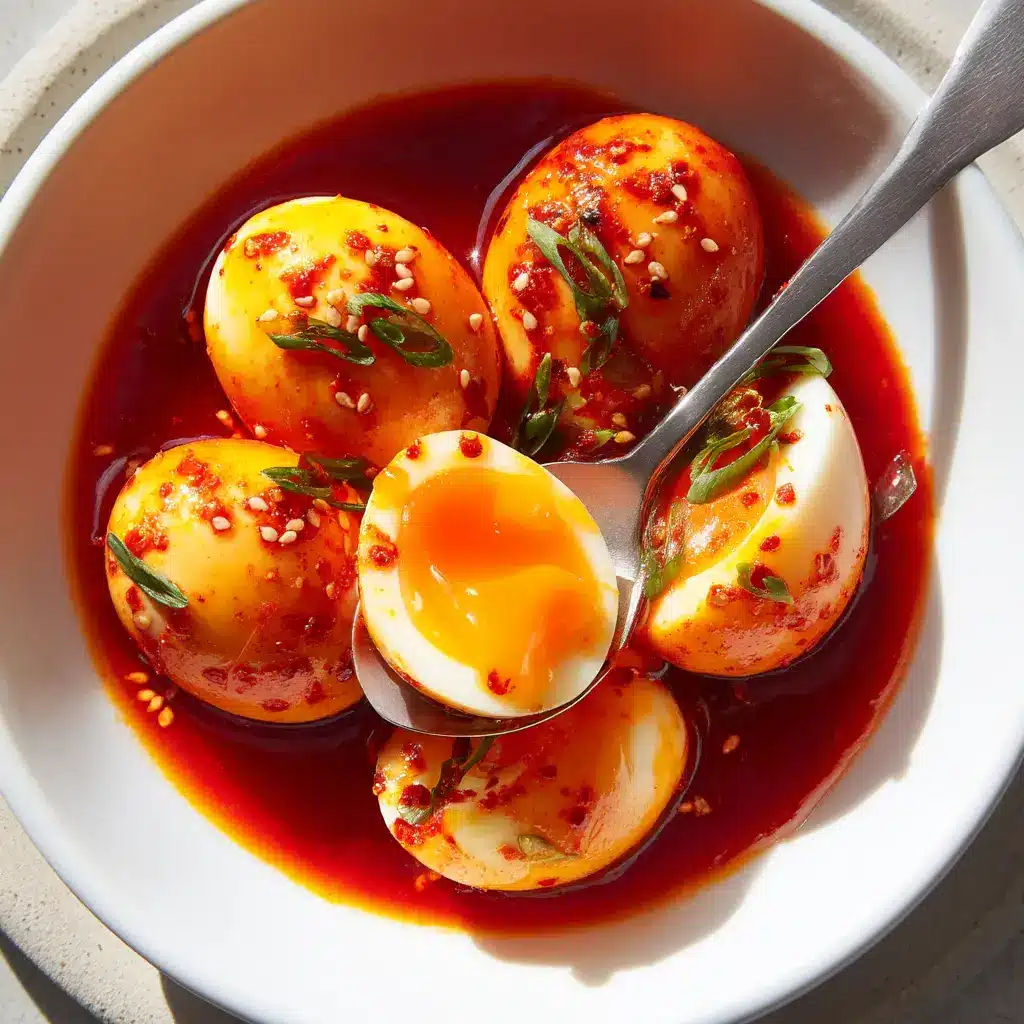
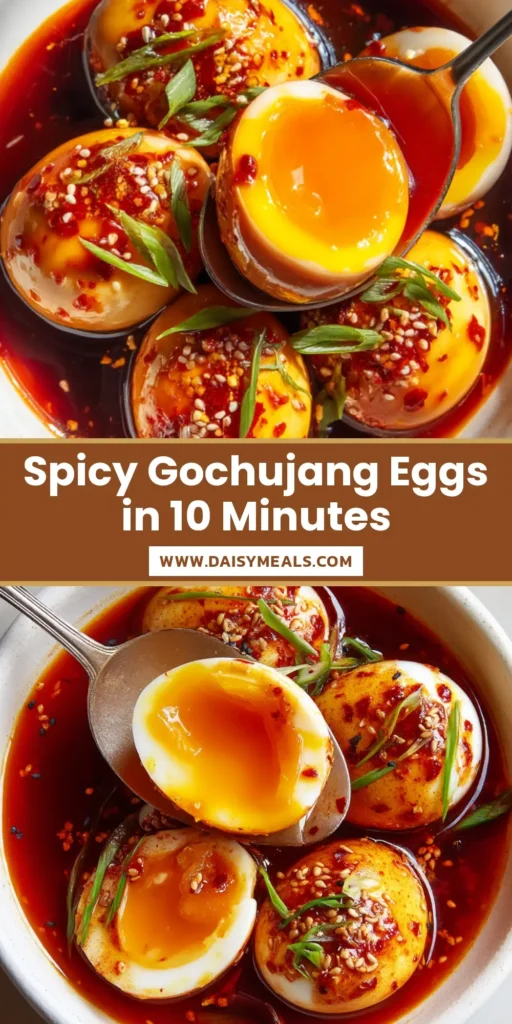
Every element of this dish is designed to tantalize your senses. From the moment you slice into the tender egg white, revealing a deeply runny, vibrant orange yolk, you know you are in for a treat.
The glossy, thick gochujang sauce clings perfectly to the eggs. It strikes a flawless balance between sweet, savory, and spicy. To finish it off, a generous sprinkle of toasted sesame seeds, bright red pepper flakes, and fresh, finely chopped green scallions adds the necessary crunch and visual pop.
Why You’ll Love This Recipe
- Unbeatable Texture: The contrast between the firm, slightly bouncy egg white and the liquid, jammy center is culinary perfection.
- Glossy, Clinging Sauce: The use of honey and soy sauce creates a beautifully thick, glossy red reduction that visibly coats the back of a spoon—and your eggs.
- Incredible Visual Appeal: Served in a white ceramic bowl, the stark contrast of the vibrant red sauce, the bright green scallions, and the deep orange yolk looks like it came straight out of a food magazine.
- Quick and Action-Oriented: From boiling water to the final garnish, this elite recipe takes barely 20 minutes to execute.
- Versatile Pairing: Whether enjoyed solo on a metal spoon or served over steaming rice, it is incredibly adaptable.
The Culinary Science of the Perfect Jammy Egg
Achieving a perfectly runny, deep orange yolk requires more than just luck. It requires precise temperature control and an understanding of egg protein coagulation.
Egg whites begin to set around 144°F (62°C), while yolks thicken at 149°F (65°C) and set completely at 158°F (70°C). Our goal is to blast the exterior with high heat to rapidly set the white, while protecting the yolk.
Dropping cold eggs directly into boiling water creates a distinct thermal shock. This shock is crucial. It firmly sets the outer proteins immediately, creating a barrier that gently insulates the delicate yolk inside.
Timing is everything. Exactly six and a half minutes is the golden window. Any less, and the white is entirely too fragile. Any more, and you lose that beautiful, deep orange runniness.
Mastering the Glossy Emulsion
The hallmark of this dish is the vibrant, glossy red gochujang sauce. It shouldn’t be watery, nor should it be a thick paste. It needs a lacquer-like finish.
Gochujang provides the earthy, spicy backbone. However, gochujang alone is quite dense. By whisking in water (or broth) and soy sauce, we thin the paste into a workable liquid.
The true secret to the gloss is the honey. As the sugars in the honey heat and reduce, they create a syrupy viscosity. This viscosity allows the sauce to gently cling to the curved surface of the soft-boiled egg without sliding off.
Ingredients & Substitutions
The Foundational Elements
Large Eggs: You need 6 large eggs (about 300g total). Ensure they are cold straight from the fridge to maintain accurate cooking times and achieve that runny center.
White Vinegar: Use 1 tbsp (15ml) of standard white vinegar in your boiling water. The slight acidity weakens the eggshell, making it significantly easier to peel without tearing the delicate cooked whites.
The Glossy Red Sauce
Neutral Oil: Start with 1 tbsp (15ml) of canola or vegetable oil. You need a neutral fat to gently bloom the aromatics without imparting overwhelming flavors.
Fresh Garlic: Mince 2 large cloves of garlic (about 1 tsp or 5g). Sautéing the garlic until fragrant provides a critical, savory aromatic base for the sauce.
Gochujang: The star ingredient! You will need 2 tbsp (30g) of this Korean fermented chili paste. It delivers a complex, deeply savory heat and a vibrant red hue.
Soy Sauce: Add 1 tbsp (15ml) of regular soy sauce. This brings necessary sodium and umami to balance the sweetness of the honey.
Honey: Measure out 1 tbsp (21g) of honey. The natural sugars provide a beautiful, mouth-watering gloss and tame the sharp heat of the chili paste.
Water or Broth: Use 2 tbsp (30ml) of water. This liquid thins the dense chili paste, allowing it to reduce and thicken properly in the pan.
Toasted Sesame Oil: Stir in 1 tsp (5ml) of toasted sesame oil right at the end. Adding it off the heat preserves its delicate, nutty aroma.
The Textural Garnishes
Toasted Sesame Seeds: Sprinkle 1 tsp (3g) over the finished dish. They provide a subtle crunch and a beautiful speckled contrast against the red sauce.
Red Pepper Flakes: Use 1/2 tsp (1g) of gochugaru or standard red pepper flakes. This enhances the visual texture and adds a final, sharp pop of heat.
Green Scallions: You will need 1/4 cup (25g) of finely chopped scallions. The sharp, fresh onion flavor cuts through the rich sauce and adds a stunning bright green pop.
Equipment Needed
Medium Saucepan: Essential for maintaining a rolling boil without overcrowding the eggs.
Slotted Metal Spoon: Critical for gently lowering the cold eggs into boiling water and safely retrieving them.
Large Mixing Bowl: You will need this to prepare a heavily iced water bath.
Non-Stick Skillet: The best tool for reducing the gochujang sauce evenly and preventing the honey from scorching.
White Ceramic Bowl: For serving! The white background forces the glossy red sauce and deep orange yolk to visually pop.
Step-by-Step Instructions
1. Prepare the Shocking Station
Before you even turn on the stove, prepare your ice bath. Fill a large mixing bowl halfway with cold water and add two large handfuls of ice cubes.
Set this bowl right next to your stove. You must be ready to transfer the eggs immediately to stop the cooking process.
2. Execute the Perfect Boil
Fill a medium saucepan with enough water to completely submerge the eggs. Bring the water to a rapid, rolling boil over high heat.
Stir in 1 tbsp (15ml) of white vinegar. Using your slotted metal spoon, gently and carefully lower the 6 cold eggs into the violently boiling water, one by one.
Set a timer for exactly 6 minutes and 30 seconds. Maintain a gentle boil; if the water is boiling too violently, the eggs will bounce and crack.
3. Shock and Peel
The second your timer goes off, use the slotted spoon to quickly transfer the eggs directly into the ice bath.
Let the eggs sit in the ice water for a minimum of 5 minutes. They must be completely cold to the touch.
Gently tap each egg on the counter to crack the shell all over. Carefully peel the shell away, ideally under a thin stream of cold running water to help the shell slip off cleanly. Set the naked, tender eggs aside.
4. Bloom the Aromatics
Place a non-stick skillet over medium-low heat. Add 1 tbsp (15ml) of neutral oil.
Once the oil shimmers, add the minced garlic. Sauté for exactly 30 seconds. Listen for a gentle sizzle and smell for a deeply fragrant, toasted garlic aroma. Do not let the garlic brown.
5. Build the Glossy Sauce
Add the 2 tbsp (30g) of gochujang, 1 tbsp (15ml) soy sauce, 1 tbsp (21g) honey, and 2 tbsp (30ml) water to the skillet.
Whisk everything together vigorously over medium heat. Bring the mixture to a gentle simmer.
Watch closely. You are looking for the sauce to bubble slightly and reduce. It should take about 2-3 minutes. The visual cue is a thick, syrupy consistency that leaves a glossy, translucent trail when you drag a spatula through it.
Remove the skillet from the heat entirely. Stir in the 1 tsp (5ml) of toasted sesame oil.
6. Coat, Halve, and Garnish
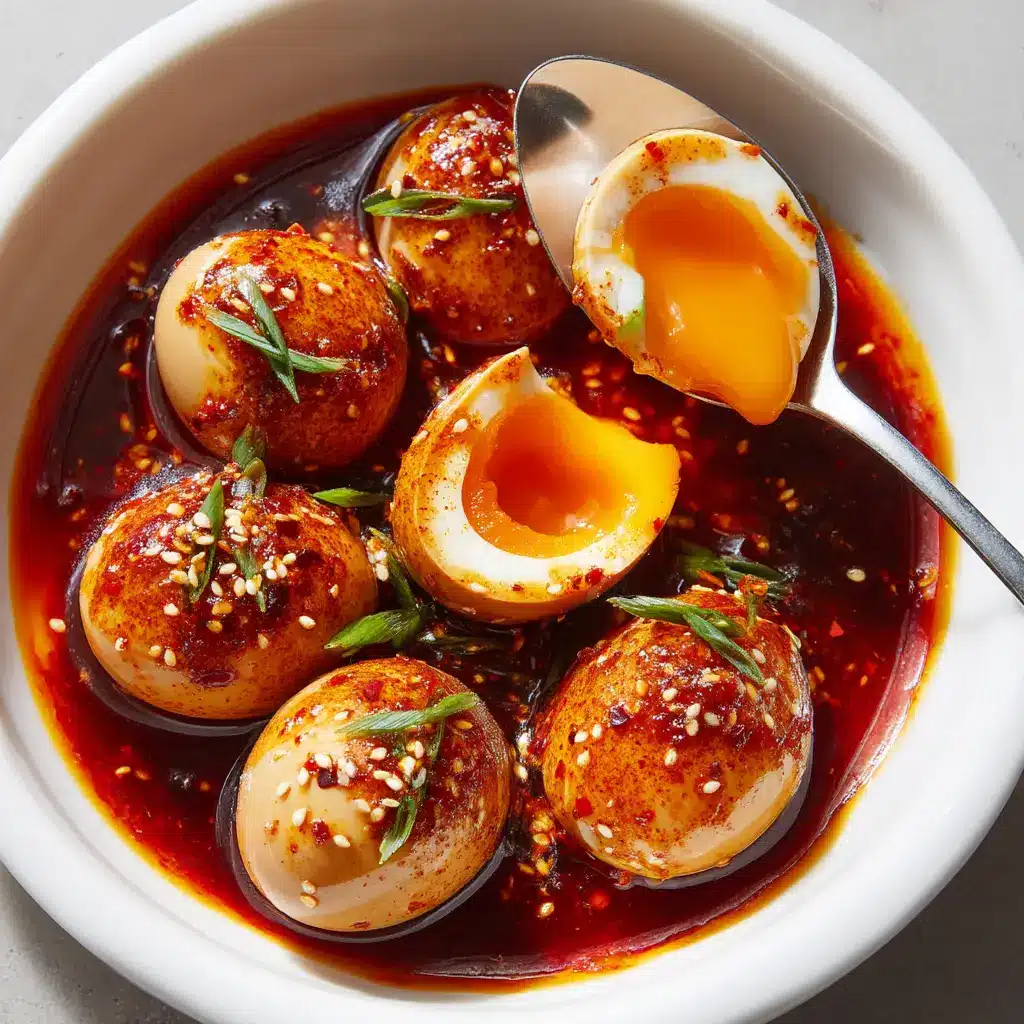
Gently drop your peeled soft-boiled eggs into the warm, glossy sauce. Toss them delicately until they are entirely coated in the vibrant red mixture.
Transfer the coated eggs to a clean white ceramic bowl. Using a sharp knife, carefully slice one of the eggs in half to reveal the perfectly runny, deep orange yolk.
To finish, sprinkle generously with the toasted sesame seeds, red pepper flakes, and finely chopped green scallions. Use a metal spoon to lift the halved egg and capture that perfect bite.
Expert Tips for Success
- Use Older Eggs: Eggs that have been in your fridge for a week are significantly easier to peel than farm-fresh eggs, as the inner membrane pulls away from the shell as they age.
- Do Not Skip the Ice Bath: Residual heat will continue to cook the yolks. The ice bath is a non-negotiable step to preserve the runny, jammy texture.
- Control Your Sauce Heat: Honey burns quickly. Keep the heat at medium or lower when simmering your gochujang sauce to prevent a bitter, scorched flavor.
- Slice with Precision: To get a clean cut through the egg without smearing the yolk, lightly oil the blade of a very sharp chef’s knife before slicing.
- Adjusting Consistency: If your sauce reduces too much and becomes a sticky paste, whisk in warm water, one teaspoon at a time, until the glossy, spoon-coating texture returns.
Storage & Reheating Guidelines
These eggs are undeniably best enjoyed fresh, exactly when the yolk is at its peak runniness and the sauce is warm. However, leftovers can be managed.
Store any fully coated, un-cut eggs in an airtight container in the refrigerator for up to 3 days. The sauce will thicken considerably in the fridge.
Do not microwave soft-boiled eggs, as they can explode. To reheat gently, let the eggs sit at room temperature for 20 minutes, or submerge them in a bowl of warm (not boiling) water for 5 minutes before eating.
Freezing is not recommended. Freezing destroys the delicate texture of the cooked egg white, turning it rubbery and unappetizing.
What to Serve With This
These incredibly flavorful eggs are intensely savory, making them the perfect centerpiece for a variety of meals.
For a fantastic, high-protein breakfast, try gently placing a halved gochujang egg over a slice of cottage-cheese-toast. The cool, creamy cheese balances the fiery red sauce perfectly.
If you are building an Asian-inspired dinner spread, these eggs are an incredible side dish for asian-beef-short-ribs or served directly on top of chicken-teriyaki-noodles.
Looking for a complete grain bowl? Pair these jammy eggs with our vibrant sriracha-honey-salmon-bowls for an absolute flavor explosion.
For a fun, interactive appetizer night, serve these alongside some crispy air-fryer-garlic-parmesan-chicken-skewers or even garlic-parmesan-fries. The glossy gochujang sauce actually makes an incredible dip for the fries!
Need to balance the meal with a refreshing salad? The cooling crunch of a cucumber-mozzarella-salad provides the ultimate palate cleanser after the spicy chili paste.
If you’re keeping things vegetarian and high-protein, adding these eggs to a plate of crispy-tofu-fried-chicken creates a deeply satisfying, meat-free feast.
And for breakfast prep enthusiasts, dropping one of these spicy eggs into our high-protein-breakfast-bowls will revolutionize your morning routine.
Frequently Asked Questions
While best enjoyed fresh for maximum yolk runniness, you can store fully coated eggs in an airtight container in the fridge for up to 3 days. Let them sit at room temperature for 20 minutes to take the chill off before eating, but do not microwave them.
For large, cold eggs straight from the fridge, drop them into violently boiling water for exactly 6 minutes and 30 seconds. Transfer them immediately to an ice bath to stop the cooking process and preserve the jammy center.
The spice level is quite moderate and well-balanced. The addition of honey tempers the heat of the gochujang, resulting in a sauce that is warmly spicy, savory, and wonderfully sweet.
Gochujang is a savory, sweet, and spicy fermented Korean chili paste made from chili powder, glutinous rice, fermented soybean powder, and salt. You can find it in the Asian aisle of most major grocery stores or at your local Asian market.
Using farm-fresh eggs makes peeling very difficult. It is best to use eggs that have been in your fridge for at least a week. Additionally, peeling the eggs submerged in cool water or under a running faucet helps the shell slip off easily.
Join Our Culinary Community!
Did you achieve the perfect runny yolk? We want to see your results! If you made these Spicy Gochujang Eggs, please leave a comment and a 5-star rating below. Your feedback helps our community grow.
Do not forget to subscribe to our weekly newsletter for more elite culinary blueprints delivered straight to your inbox. Pin this recipe to your favorite Pinterest board so you never lose track of the ultimate glossy sauce technique!
Recipe Schema
Spicy Gochujang Eggs: Jammy Yolks in a Glossy Sauce
Ingredients
Equipment
Instructions
- Fill a large mixing bowl halfway with cold water and add two large handfuls of ice cubes. Set aside near the stove.
- Bring a medium saucepan of water to a rolling boil. Stir in 1 tbsp (15ml) of white vinegar. Carefully lower the 6 cold eggs into the water using a slotted spoon. Boil for exactly 6 minutes and 30 seconds.
- Immediately transfer the eggs to the ice bath. Let them chill for 5 minutes. Gently tap the shells and carefully peel them, preferably under cool running water. Set aside.
- Heat 1 tbsp (15ml) of neutral oil in a non-stick skillet over medium-low heat. Add the minced garlic and sauté for 30 seconds until deeply fragrant.
- Whisk in 2 tbsp (30g) gochujang, 1 tbsp (15ml) soy sauce, 1 tbsp (21g) honey, and 2 tbsp (30ml) water. Simmer for 2-3 minutes until the sauce reduces, thickens, and becomes highly glossy. Remove from heat and stir in 1 tsp (5ml) of toasted sesame oil.
- Gently toss the peeled eggs in the warm sauce until fully coated. Transfer to a white ceramic bowl, carefully halve one egg to reveal the yolk, and garnish with toasted sesame seeds, red pepper flakes, and finely chopped scallions.
Notes
Do not skip the ice bath; it is critical for stopping the cooking process and keeping the yolk runny.
If your sauce thickens too much, whisk in a teaspoon of warm water until the glossy texture returns.